A title company website has to look good and do real work. Color schemes and photography matter, and so do the features that bring agents back, build trust, and turn visitors into clients.
This checklist covers the 15 features that matter most, based on what real estate agents and lenders look for, what good security practice calls for, and what turns visitors into clients.
Essential Features (Must Have)
1. Mobile-Responsive Design
Agents use their phones at listing appointments, open houses, and in the field. If your website does not work well on a phone, your most important audience will have a hard time using it. Mobile design is the foundation everything else sits on.
2. Net Sheet Calculator
One of the tools agents ask for most. A seller net sheet that uses your title insurance rates and county-level recording fees lets agents prepare an estimate on the spot, at the listing appointment. It is also one of the best reasons for an agent to come back to your website.
3. Closing Cost Estimator
Buyers want to know what they will pay at closing. An interactive calculator that breaks down title insurance premiums, recording fees, transfer taxes, and lender-required fees gives visitors a reason to engage with your site, and gives you a lead capture opportunity.
4. SSL Certificate and Secure Hosting
ALTA Best Practices include protecting non-public personal information, and an SSL certificate is a basic part of any secure website. Visitors see the padlock icon and trust your site. Without it, browsers display “Not Secure” warnings. Your compliance team can tell you what else applies to your company.
5. Clear Contact Information
Phone number, email, physical address, and hours, visible on every page rather than in a footer link alone. Include a click-to-call phone number for mobile users. Title transactions are time-sensitive and people need to reach you quickly.
Competitive Advantages (Should Have)
6. Service Area Pages
Dedicated pages for each city or county you serve, with locally relevant content: county recording fees, local transfer tax rates, and courthouse information. These pages support visibility for “[city] title company” searches and demonstrate genuine local expertise.
7. Wire Fraud Prevention Messaging
Wire fraud is the title industry’s most visible risk. A dedicated page or prominent section explaining your wire verification procedures, how you protect client funds, and what clients should watch for builds trust and demonstrates professionalism.
8. Online Order Placement
A secure form where agents and lenders can submit title orders at any hour, not just during business hours. This does not need to integrate with your title production software immediately. Even a well-structured form that sends to your intake email removes friction from the ordering process.
9. Fast Load Speed
A page that loads quickly on a phone is a page people finish reading. Optimize images, use caching, and choose hosting built for performance. Test your own site on a phone, on a cellular connection, the way an agent would.
10. Educational Content
Blog posts or guides answering common questions, such as “Who pays closing costs?”, “What is title insurance?”, “How does escrow work?” This content can surface in search engines and AI assistants, and gives agents shareable resources for their clients.
Growth Features (Nice to Have)
11. Partner Portal
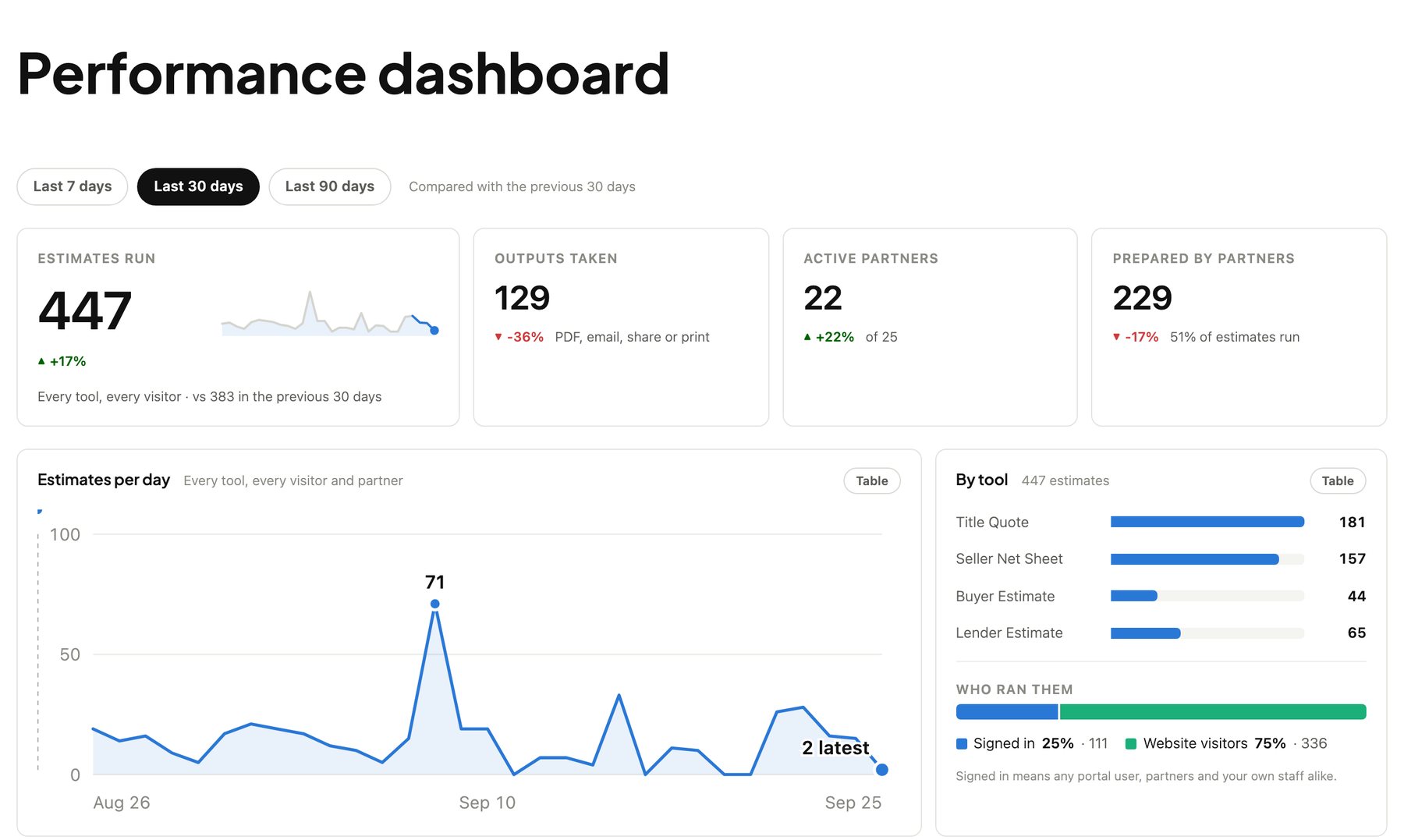
A portal where agents and lenders sign in, use your tools, save the estimates they prepare, and share them with clients under their own name, with your company behind the numbers. It turns your website from a brochure into something partners come back to. See how a Partner Portal works.
12. Google Business Profile Integration
Your website and Google Business Profile should reinforce each other. Consistent NAP (name, address, phone) data, client reviews shown on your site, and a Google Maps embed on your contact page all support local search visibility.
13. Schema Markup
LocalBusiness, FAQ, Article, and Organization schema help search engines and AI platforms understand your content. Structured data gives them a clear, machine-readable description of who you are, where you work, and what each page answers.
14. Blog with Regular Updates
Search engines and AI assistants favor content that is current. A blog that publishes monthly, or even quarterly, keeps your site fresh in their eyes. Market updates, regulatory changes, and educational guides all work.
15. Analytics and Tracking
Google Analytics, Google Search Console, and conversion tracking so you know how many people visit, where they come from, and what they do once they arrive. You cannot improve what you do not measure.
How to Prioritize When Budget Is Limited
Very few title companies can implement all 15 features at once, and trying to do so often leads to a half-finished website that launches late and over budget. A phased approach produces better results and lets you learn from real user behavior before investing in advanced features.
Phase 1: The foundation (items 1-5). Mobile design, a net sheet calculator, a closing cost estimator, SSL security, and clear contact information. These five items cover what agents need most and the basics of a secure website. Budget here first and get these right before moving on.
Phase 2: Competitive differentiation (items 6-10). Service area pages, wire fraud messaging, online order placement, fast load speed, and educational content. These are the features that separate you from competitors who also have a basic modern site. Service area pages and educational content are particularly high-value because they compound over time: every page you publish is another opportunity to rank in search results and get cited by AI platforms.
Phase 3: Growth and scale (items 11-15). A Partner Portal, Google Business Profile integration, schema markup, a regular blog, and analytics. These features make sense once you have a solid foundation and are ready to scale your digital presence. A Partner Portal, for example, is most valuable when the calculators and tools that make it worth signing into are already in place.
The minimum viable approach. If budget is extremely tight, start with a clean mobile-responsive site with one calculator (seller net sheet), clear contact information, and SSL. You can add features incrementally as revenue allows, and each addition compounds the value of what you have already built.
What to skip entirely. Avoid spending budget on features that look impressive but do not drive business: animated homepage videos, virtual office tours, complex interactive timelines, or chatbots that frustrate more than they help. Put each dollar toward tools designed for the way agents work, or content that answers the questions your clients ask.
Red Flags When Evaluating Web Providers
Choosing the wrong web provider is expensive, in time and missed opportunities as well as dollars. The title industry has enough unique requirements that a generalist web agency can easily deliver a site that looks polished but misses the mark. Watch for these warning signs during the evaluation process.
They cannot explain how they handle state-specific rates. If you ask how the calculators will handle your state’s title insurance rate schedule and the answer is vague or involves “national averages,” walk away. Calculator accuracy is non-negotiable. An inaccurate net sheet damages your credibility with agents and can create real problems at the closing table.
They do not ask about your compliance requirements. A web provider who does not bring up ALTA Best Practices, wire fraud prevention messaging, or data security during the sales process does not understand your industry. You should not have to educate your vendor on the basics of how title companies protect client data.
They own your domain or hold your site hostage. Some web providers register the domain in their name or build on proprietary platforms where you cannot take your site with you if you leave. Before signing anything, confirm that you own your domain, that you will have access to your site files, and that there is a clear exit process if the relationship ends.
They promise specific search rankings. No reputable SEO professional guarantees “page one rankings” or “number one on Google.” Search results depend on dozens of factors, many of which are outside anyone’s control, including Google’s own algorithm changes. A good provider will explain their SEO approach, set realistic expectations, and track progress over time. Anyone guaranteeing specific positions is either dishonest or does not understand how search actually works.
Their portfolio has no title or real estate industry examples. Building websites for restaurants, dentists, and e-commerce stores does not prepare a provider for the nuances of the title industry. Look for providers who have built sites for title companies, escrow companies, or at minimum real estate-adjacent businesses. Ask for references from those clients and actually call them.
They quote a price but not a timeline or scope. A proposal that says “$5,000 for a new website” without specifying what is included, how many pages, what features, what the revision process looks like, and when it will launch is a recipe for disappointment. Insist on a detailed scope of work with milestones, deliverables, and a realistic timeline before you commit.
They disappear after launch. Ask what happens after the site goes live. Who handles security updates? Who adjusts calculator rates when your state changes its fee schedule? What does ongoing support cost? A website without maintenance is a depreciating asset. The best provider relationships include a clear support plan from day one.
How to Use This Checklist
Score your current website against these 15 items, starting with the Essential and Competitive Advantage categories. Each item is a place where your website can carry more of the service your team already provides.
When you are ready to talk about a new site, see how we approach title company website design.
References to ALTA Best Practices and compliance in this article are for informational context only and do not constitute compliance advice.
About TitleThrive
TitleThrive designs and builds websites for title, escrow, and settlement companies. Every website comes with a Title Quote, Seller Net Sheet, Buyer Estimate, Lender Estimate, mortgage calculators, a Partner Portal, and lead capture, designed for the way title professionals work. Request a demo or explore our features.
Published by TitleThrive Editorial · Last updated September 25, 2026